Generates Synthetic Data for all Quadcopter Vision-Based Navigation Studies
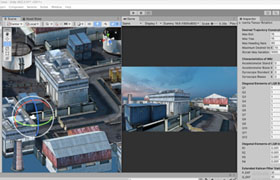
The AIGNC at ITU ARC has reached the capability to produce synthetic data for virtually all aspects of quadcopter vision-based navigation studies. This includes tasks like object detection, depth estimation, and visual odometry, employing camera setups equipped with realistic pinhole and fisheye lenses, whether monocular, binocular, or trinocular.
PhD candidate Seyed Erfan Seyed Roghani, a member of the research group of ITU Aerospace Research Center “AIGNC”, which includes faculty members from the Aviation Institute, has achieved a milestone in the realm of aerial technology by developing a cutting-edge platform tailored for quadcopters. This Unity-based platform introduces synthetic vision-based navigation data, reshaping the landscape of quadcopter control methodologies. The platform, meticulously crafted by Roghani, integrates popular quadcopter control techniques, providing a versatile and powerful tool for researchers and developers. Leveraging Unity's advanced graphical capabilities, the platform stands out by simulating various camera lenses, including pinhole and fisheye, motion blur, and lens distortion. What sets this platform apart is its ability to generate synthetic vision-based navigation data explicitly designed for quadcopters. By seamlessly integrating pose data and depth images, it meets the unique requirements of quadcopter navigation, addressing challenges specific to this aerial platform. Beyond its fundamental navigation capabilities, the platform opens doors to the application of artificial intelligence (AI)-based image processing techniques. Notably, researchers can implement object detection and semantic segmentation, expanding the platform's utility beyond navigation into broader AI applications. Roghani's innovation represents a significant leap forward in the field of quadcopter technology, offering a comprehensive and adaptive solution for both navigation and advanced image processing. As the platform continues to evolve, it holds the promise of reshaping how quadcopters navigate and perceive their surroundings, fostering advancements in various industries reliant on this emerging technology.
Locations
İTÜ Aerospace Research Center
İTÜ Havacılık ve Uzay Tek. Uyg. Ar. Merkezi, Maslak, İstanbul
+90 212 285 7554
show on a mapLabs in Aero-Astro Building
İTÜ Uçak ve Uzay Bilimleri Fak., 3. Kat Oda No: 312-315
+90 212 285 3148
show on a map